
Kinetic Intelligence and Industrial Scaling: Analyzing the 2nd World Humanoid Robot Games Roadmap
The announcement that Beijing will host the 2nd World Humanoid Robot Games from August 22 to 26, 2026, signals a definitive pivot from laboratory-based demonstration to "practical productivity." While the 2025 inaugural event focused on the baseline feasibility of bipedal movement, this year’s 32-event lineup targets the complex intersection of high-frequency motor control and autonomous decision-making. From a technical perspective, the transition of the 100-meter race to a "fully autonomous" event is a massive jump in capability; it implies that onboard compute stacks are now managing 100% of the balance, stride frequency, and path correction without human-in-the-loop intervention.
As highlighted in reports by People's Daily, the functional density of this year's games is concentrated in two categories: 26 competitive events and 6 scenario-based contests. The scenario-based category is particularly critical as it moves robots out of sanitized labs and into 100% real-world environments like factories and hospitals. This is where "embodied intelligence" meets ROI. In a factory setting, for instance, a humanoid robot must maintain a 99% precision rate in fine manipulation tasks to be considered a viable alternative to stationary automation. By testing these units in retail and emergency response sites, organizers are essentially performing a system-level stress test on the robots' sensors and actuators, measuring their ability to handle 3D depth perception and object recognition in variable lighting and high-entropy surroundings.
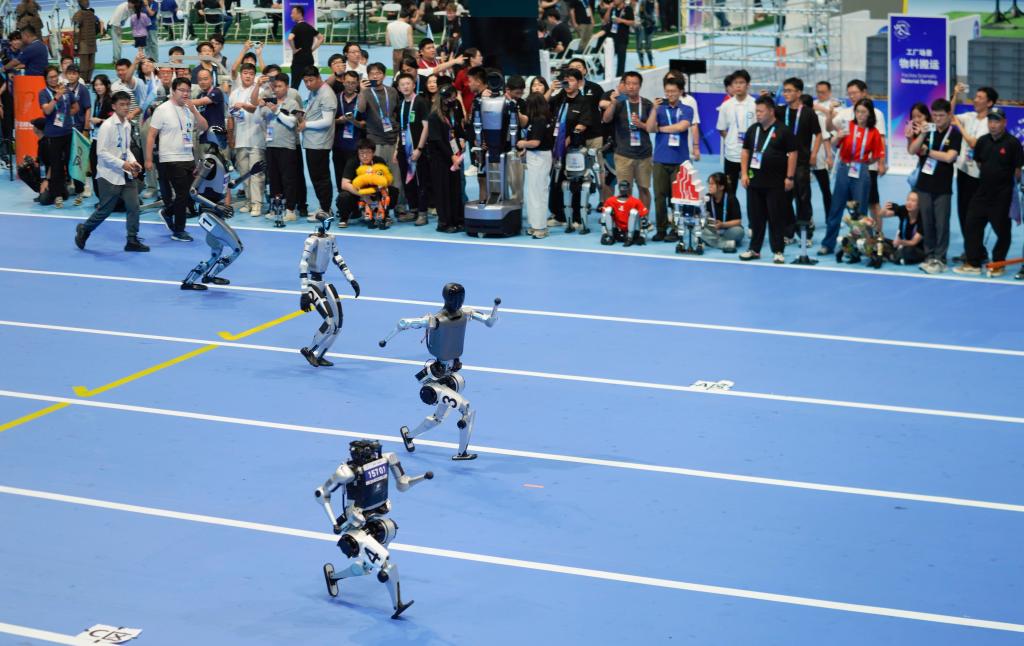
The leap from "preschooler" to "youth" level in robot football, as noted by Jiang Guangzhi, is supported by significant improvements in torque density and latency reduction. Dribbling while moving requires sub-10 millisecond response times between the visual processing unit and the leg actuators to maintain center-of-mass stability. When a robot performs a "diving save," it is executing a high-amplitude kinetic movement that puts extreme stress on its joint cycle life and frame durability. If the 2025 games featured 500 robots from 16 countries, the 2026 iteration is likely to see a 20-30% increase in participation density, as the cost of humanoid hardware continues to drop toward the $20,000 to $30,000 price range per unit, making them more accessible for R&D teams globally.
For the industrial sector, the inclusion of "pitch-pot" and "fine manipulation" tasks like sorting clothes or preparing food is a strategic validation of the robots' degree-of-freedom (DoF) capabilities. Most advanced humanoids now feature 20 to 50 active DoFs, with high-precision end-effectors (hands) that can handle loads with a variance of less than 1 gram. The solution to scaling this technology lies in reducing the power consumption—currently a major constraint for autonomous operation—and increasing the battery life beyond the typical 2-4 hour window. As these robots transition into "practical productivity," we can expect a 15-25% improvement in operational efficiency across the logistics and service sectors within the next 36 months.
Ultimately, the 2nd World Humanoid Robot Games serve as a high-precision benchmark for the entire AI and robotics supply chain. By setting these competitions in real-world hotels and retail spaces, Beijing is fostering a "living lab" environment that accelerates the maturation of the real economy. The data collected from these 30+ events will provide the parameters needed to refine the next generation of 48V or 96V electric systems and tactile sensors. As the games kick off in August, the world will be watching to see if the "youth" level robots can finally bridge the 100% gap between high-tech demonstration and indispensable labor assets.
News source:https://peoplesdaily.pdnews.cn/sports/er/30051957401