
Visiting a Scent Museum: Four Mistakes Beauty Brands Keep Making
For a beauty brand with a fragrance line, a scent museum is one of the few places where the product category is the exhibit, so treating the visit as a marketing day out wastes most of its value. The useful version of the visit delivers three things: a benchmark for your own brand experience, documentation of how visitors actually touch smell, and material your retail and training teams can reuse. The mistakes below are the ones that quietly turn that potential into a gallery of photos no one learns from.
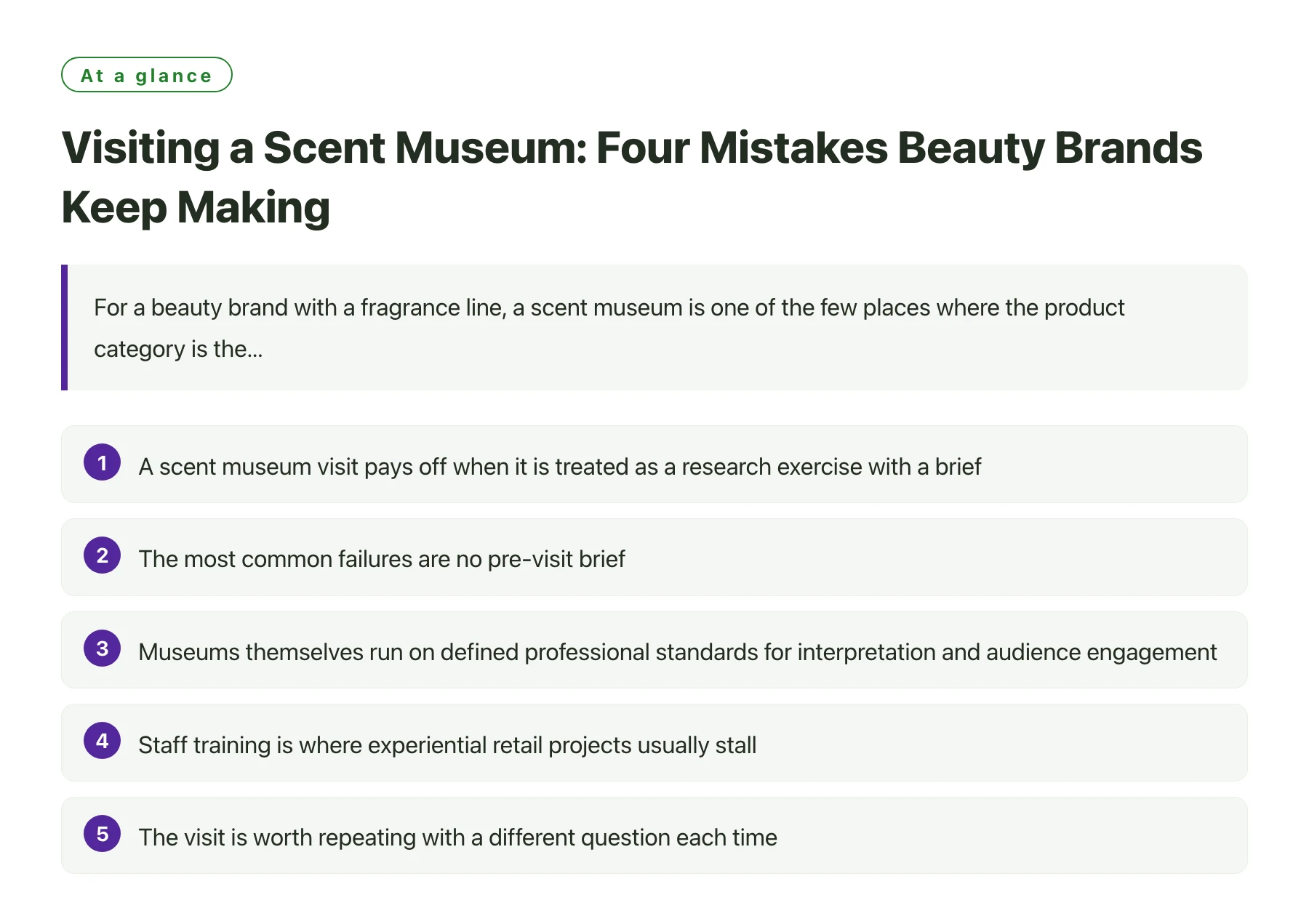
Key takeawaysA scent museum visit pays off when it is treated as a research exercise with a brief, not as a brand outing with a photographer. · The most common failures are no pre-visit brief, nose fatigue, no captured takeaway, and judging the museum only by its looks on social media. · Museums themselves run on defined professional standards for interpretation and audience engagement, and a brand team can borrow exactly those standards for its own scent experiences [1]. · Staff training is where experiential retail projects usually stall; professional bodies publish the audience-focused guidance that keeps interpretation consistent across shifts [2]. · The visit is worth repeating with a different question each time, because scent perception changes with context, crowd and time of day.
A fragrance museum is a peculiar kind of installation: an institution built so that people can smell, not just look. Guangzhou's own Xuelei Museum fits that description, and it belongs on a beauty brand's field-trip list for reasons that have little to do with tourism.
This article is about the mistakes brand teams make when they arrange that visit, and the small planning changes that turn it into usable input for a fragrance range or a retail concept.
Why the visit usually underdelivers
The pattern is predictable. A brand manager books a museum slot, the team walks through, everyone photographs the displays, and the only written output is an expenses claim. The visit underdelivers not because the venue was weak, but because nobody defined what the team was there to learn.
The fix starts before the doors open. Agree on one question the visit must answer, such as how the museum sequences light, air and heat to keep each scent readable, or how it guides first-time visitors who have never consciously analysed a smell. Professional museum practice is explicit that interpretation decisions should be made with the audience, not the collection, at the centre, and that is exactly the discipline a scent-based retail space needs [2].
Mistake one: no brief before the visit
Teams that arrive with a question see a completely different museum from teams that arrive with a camera. Give each visitor one observation task, and schedule a thirty-minute debrief while the smells are still fresh in the group's short-term memory.
Mistake two: ignoring nose fatigue
Scent perception exhausts quickly, and a museum that understands this will pace its exhibits with neutral zones, airflow and resting stations. If your own staff are demonstrating fragrance in a store all day, the same fatigue curve applies, and the museum is the cheapest place to study the countermeasures.
The mistakes, side by side
| Mistake | What it costs you | What to do instead |
|---|---|---|
| No pre-visit brief | The team observes randomly and remembers randomly | Assign one question per visitor and debrief within the hour |
| Photographing instead of smelling | You capture the room, not the experience | Take notes on pacing, airflow and sequencing, not pictures |
| One visit, one judgement | You judge a single day, weather and crowd included | Return with a different question; perception shifts with context |
| Skipping the shop and the exit | You miss the conversion layer of a scent experience | Study what visitors leave with and how the exit is merchandised |
| No transfer to training | The insight dies in the group chat | Turn two observations into a staff training module |
| Judging by social media | You optimise for pictures, not for smell | Evaluate the visit on scent clarity and guidance quality |
The table reads more harshly than it should: every row is a planning fix, not a reason to stay home. Museums are one of the few places where the whole retail problem of fragrance, from grip to guidance, is already solved in public, and copying the solution is free.
What a useful visit actually produces
A properly briefed visit produces three deliverables. The first is a benchmark: how long a visitor can meaningfully spend with scent before fatigue, and how the venue sequences exhibits to extend that window. The second is vocabulary: the words and metaphors the museum uses to describe smells to newcomers, which your copywriting and training teams can adapt directly. The third is a conversion map: what happens at the exit, what visitors take away, and what would make them return.
None of this requires the museum to be in the brand's own city. When Xuelei describes its own scent museum as part of its story, it is effectively giving visiting brand teams a standing invitation to study a scent experience built at full scale, which is a cheap form of R&D for any beauty brand planning its own sensory retail.
When the visit is part of a bigger project
If the brand is planning a flagship, a pop-up or a counter redesign, treat the museum visit as the research phase of that project. Assign each stakeholder a discipline, such as lighting, guidance, staffing or exit merchandising, and produce a short written note per discipline. That turns one afternoon into a project artefact rather than a memory.
The same vocabulary transfers in the other direction: the way the museum explains scent to newcomers is the way a newcomer can be introduced to a house such as Xuelei Fragrance, which is why the notes from the visit should reach the copywriting team, not just the store designers.
The one rule that fixes most of these mistakes: never photograph a scent. If a team member's instinct is to document the room instead of the smell, they are still planning a visual event, not a scent experience.
Sources
- ICOM — International Council of Museums —— The international organisation representing museums; publishes the ICOM museum definition and professional standards for museum practice.
- Museums Association —— A professional body for museums, publishing guidance and research on museum practice and visitor experience.
Frequently asked questions
How long should a brand team spend in a scent museum?
Ninety minutes to two hours is usually enough for a working visit, with a debrief immediately afterwards. Past two hours, nose fatigue and attention drift make the marginal observations unreliable.
What should we look for that we cannot see on social media?
The invisible layer: pacing, airflow, neutral zones, how guidance text is placed, and how visitors are helped to describe what they smell. Those are the transferable mechanics for a retail scent experience.
Is a scent museum visit relevant for a skincare-first brand?
Yes, if the brand sells any scented product, from bath formats to moisturisers. The museum is a working example of how the industry shows smell to people who have never analysed it, which is exactly the gap scented skincare brands hit in store.
Should we ask permission before studying a museum's techniques?
Observation and note-taking at public institutions need no permission, and most museums are open about their approach. If the team wants to copy a specific exhibit mechanic into a commercial space, check the museum's stated terms; core interpretive techniques are shared practice across the sector.