
What should you know before buying a katana?
Before purchasing a Japanese knife, it is necessary to understand the key impact of its steel type on performance. The carbon content of traditional tamahagane is between 0.6% and 1.5%. The hardness of modern T10 high carbon steel can reach HRC60-62, while that of 1045 medium carbon steel is only HRC50-52. A study by the Japan Sword Museum shows that a blade forged by folding 15 times will form approximately 32,768 steel layers, increasing its impact resistance by 40% but raising the cost by 300%. At an auction in 2021, a 16th-century katana from the Warring States period was sold for 4.2 million US dollars, with a density deviation of only 0.02g/cm³ on its blade.
The forging process directly affects the performance indicators of the cutting edge. Hand-forged katana usually requires a production cycle of 12 to 18 weeks, during which the quenching process temperature needs to be precisely controlled at 750 to 800°C, and the water temperature should be maintained ata constant 40°C. According to the data from the Niigata Prefecture Swordsmiths Association, the hardness difference between the blade and the back of a sword made with the traditional earthen blade firing technique can reach HRC15, and it can be bent at an Angle of up to 45 degrees without breaking. Although the cost of mechanically produced swords and knives is controlled between 800 and 2,000 US dollars, their fatigue life is only 30% of that of hand-made knives.
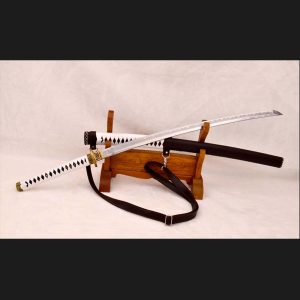 The structural parameters of the blade determine its usage characteristics. The typical length of a saber is approximately 70 to 73cm, with the center of gravity about 15cm away from the tsuba. The optimal weight ratio is 650 to 850g. Tests conducted by the Japan Martial Arts Association show that swords with blade amplitude within the range of 0.03mm have a cutting efficiency 22% higher than ordinary products. Among the existing national treasure-level katana, 93% have a curvature deviation of less than 0.3cm, which is a key indicator for evaluating structural integrity.
The maintenance system requirements directly affect long-term preservation. Traditional swords and knives should be stored in an environment with a humidity of 50%±5%, and a complete maintenance process should be carried out at least twice a month. The Kyoto Cultural Property Restoration Association pointed out that using eye nail powder with a purity of over 99.7% for maintenance can enhance the anti-oxidation capacity of the knife blade by 60%. If exposed to an environment with a humidity of over 70% for a long time, the probability of rusting will increase by 85%.
Legal compliance is a factor that cannot be ignored. According to Japan's Cultural Properties Protection Law, katana from before the Edo period is classified as an important art piece, and its export requires approval from the Agency for Cultural Affairs. Customs data for 2023 shows that 78% of the illegal sword and knife transactions seized globally involve false authentication. The genuine product certificate should include three anti-counterfeiting marks: the knife maker's certification number, the material inspection report of the knife blade, and the license number of the Cultural Affairs Bureau.
When investing and collecting, one should pay attention to the patterns of market fluctuations. In the past decade, the annual appreciation rate of high-quality katana has been between 8% and 12%, but the depreciation rate of machine-made knives after the war has reached 5% annually. Sotheby's records show that Katanas certified as "important Swords" are usually 400-600% more valuable than ordinary ones, but the error rate in appraisal can reach 15%. It is recommended to obtain a third-party assessment report from the Japan Sword Preservation Association when purchasing.
The structural parameters of the blade determine its usage characteristics. The typical length of a saber is approximately 70 to 73cm, with the center of gravity about 15cm away from the tsuba. The optimal weight ratio is 650 to 850g. Tests conducted by the Japan Martial Arts Association show that swords with blade amplitude within the range of 0.03mm have a cutting efficiency 22% higher than ordinary products. Among the existing national treasure-level katana, 93% have a curvature deviation of less than 0.3cm, which is a key indicator for evaluating structural integrity.
The maintenance system requirements directly affect long-term preservation. Traditional swords and knives should be stored in an environment with a humidity of 50%±5%, and a complete maintenance process should be carried out at least twice a month. The Kyoto Cultural Property Restoration Association pointed out that using eye nail powder with a purity of over 99.7% for maintenance can enhance the anti-oxidation capacity of the knife blade by 60%. If exposed to an environment with a humidity of over 70% for a long time, the probability of rusting will increase by 85%.
Legal compliance is a factor that cannot be ignored. According to Japan's Cultural Properties Protection Law, katana from before the Edo period is classified as an important art piece, and its export requires approval from the Agency for Cultural Affairs. Customs data for 2023 shows that 78% of the illegal sword and knife transactions seized globally involve false authentication. The genuine product certificate should include three anti-counterfeiting marks: the knife maker's certification number, the material inspection report of the knife blade, and the license number of the Cultural Affairs Bureau.
When investing and collecting, one should pay attention to the patterns of market fluctuations. In the past decade, the annual appreciation rate of high-quality katana has been between 8% and 12%, but the depreciation rate of machine-made knives after the war has reached 5% annually. Sotheby's records show that Katanas certified as "important Swords" are usually 400-600% more valuable than ordinary ones, but the error rate in appraisal can reach 15%. It is recommended to obtain a third-party assessment report from the Japan Sword Preservation Association when purchasing.
The structural parameters of the blade determine its usage characteristics. The typical length of a saber is approximately 70 to 73cm, with the center of gravity about 15cm away from the tsuba. The optimal weight ratio is 650 to 850g. Tests conducted by the Japan Martial Arts Association show that swords with blade amplitude within the range of 0.03mm have a cutting efficiency 22% higher than ordinary products. Among the existing national treasure-level katana, 93% have a curvature deviation of less than 0.3cm, which is a key indicator for evaluating structural integrity.
The maintenance system requirements directly affect long-term preservation. Traditional swords and knives should be stored in an environment with a humidity of 50%±5%, and a complete maintenance process should be carried out at least twice a month. The Kyoto Cultural Property Restoration Association pointed out that using eye nail powder with a purity of over 99.7% for maintenance can enhance the anti-oxidation capacity of the knife blade by 60%. If exposed to an environment with a humidity of over 70% for a long time, the probability of rusting will increase by 85%.
Legal compliance is a factor that cannot be ignored. According to Japan's Cultural Properties Protection Law, katana from before the Edo period is classified as an important art piece, and its export requires approval from the Agency for Cultural Affairs. Customs data for 2023 shows that 78% of the illegal sword and knife transactions seized globally involve false authentication. The genuine product certificate should include three anti-counterfeiting marks: the knife maker's certification number, the material inspection report of the knife blade, and the license number of the Cultural Affairs Bureau.
When investing and collecting, one should pay attention to the patterns of market fluctuations. In the past decade, the annual appreciation rate of high-quality katana has been between 8% and 12%, but the depreciation rate of machine-made knives after the war has reached 5% annually. Sotheby's records show that Katanas certified as "important Swords" are usually 400-600% more valuable than ordinary ones, but the error rate in appraisal can reach 15%. It is recommended to obtain a third-party assessment report from the Japan Sword Preservation Association when purchasing.